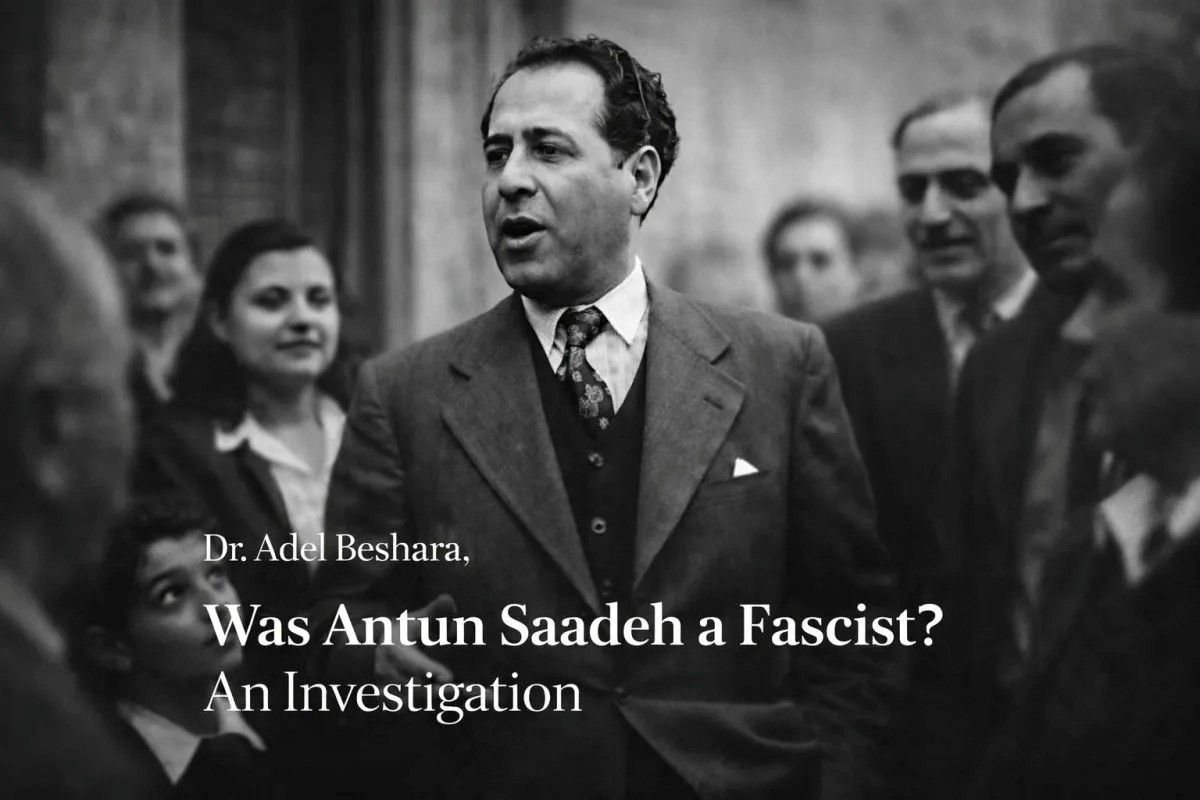
Depictions of Saadeh as a Fascist or as a lackey of Fascism emerged in the West as an aspect of Western political propaganda. It can be traced back to the mid-1930s when the Western press, riding on a wave of false reports in the local press about Saadeh’s ‘Fascism’, engaged in name-calling without cross-checking with Saadeh or investigating the veracity of those reports. The ‘Fascist’ tag then entered Western political literature as a universal ‘fact’ and to this day continues to resonate unrebutted and unchallenged.
The normal scholarly procedure to determine whether Saadeh was a fascist would be to start with a definition of Fascism. It is generally accepted that Fascism is a type or set of political actions or a mass movement focused on extreme state power. For fascism, the state is the “purpose and the individual the means”. Under this rubric, it is possible to identify a number of general characteristics that Fascist movements tend to have in common:
• Extreme militaristic nationalism
• Contempt for electoral democracy
• Disapproval of political and cultural liberalism
• A belief in natural social hierarchy and the rule of elites
• Opposition to Marxism and leftist ideals
• Totalitarian ambitions
• Corporatism and syndicalism
• Imperialism
• Scapegoating and violence
A key aspect of Saadeh’s ‘fascist’ image in the West is that he was a ‘construct’ of Fascist Italy. This is open to speculation. Thus far no concrete evidence has surfaced to either confirm or deny any contact between Saadeh and Fascist Italy. What we do know is that the Italian fascists disowned Sa’adeh, pretty much as had their Nazi allies in Germany.
Many claims are made that the Italians tried to recruit politicians in the Middle East in the 1930s for inroads into the region. Sa’adeh himself, in his 1935 First Platform Speech, spoke briefly about these claims. Many years later, in 1953, the Lebanese politician Kamal Jumblatt reported that the Italians had approached first-tier politicians in Lebanon with the proposal to found a Fascist party with Rome’s financial and political support. He reported this in his party’s mouthpiece, al-Anba’, without disclosing names or dates. When all efforts failed, the Italians, according to Jumblat, then approached second-tier politicians and found what they wanted in Sa’adeh. The unsupported claim turned out to be a reproduction of false reports on Italian (and German) links with Sa’adeh that appeared in the al-Masa’ newspaper in 1936.
Nadim Makdisi (also Maqdisi), who knew Sa’adeh on a personal level, questioned the credibility of the claim. He noted:
There is no evidence to substantiate that claim. In the first place, Sa’adeh was always in financial difficulty, as is known to this writer to be a fact. This was before founding his party and continued after, up to the day he fled the country to South America. Before he proclaimed the Party, he lived in a cheap room near the American University of Beirut and gave private lessons in German to supplement his meagre income. At times, he did not have enough money to pay for food and was invited to the homes of Party members for his meals. If he had accepted financial help from the Italians, as was claimed by al-Anba’, he surely would have solved his board and lodging problem.
Several other indicators cast strong doubt on Saadeh’s connection to Fascist Italy. First, no evidence to that effect has ever turned up. At one point, the French sought the assistance of prominent lawyers to prove the charge, but to no avail. Second, the refusal of the German-Italian
Truce team that assumed control from the ousted French administration in Syria-Lebanon in 1940, following France’s capitulation to the Axis powers, to release the incarcerated members of Saadeh’s party indicates that Saadeh had no connection with either the German Nazis or the Italian Fascists. Third is Saadeh’s lukewarm attitude to the Axis powers in general and Fascist Italy in particular.
Using ‘external features’ to draw Saadeh to Fascism is also dangerous because it leads to conclusions based exclusively on these features. Comparing anything from such a narrow perspective fuses the core with the peripheral without regard for their points of congruence and points of divergence. This does not work in all cases, particularly with political movements where the need to differentiate between beliefs and actions, method and message, ends and means, is ever present.
It is widely assumed that just because Saadeh found some ‘Fascist’ forms alluring for his purpose then he must be a Fascist. But is that really enough to make him a ‘Fascist’? What if his vision can be shown to be incompatible with fascism? What would become of the Western approach if some of the ‘external forms’ utilized by Saadeh turn out to be similar in style to the Communist parties of his time! Would that make him a Communist? Depicting him as a ‘Fascist’ strictly on external forms is deceptive because it misses the whole point of his endeavor. It disregards the core meaning of his national ideology and obscures the substance of his message. It is also reductive because it narrows his ideas down to basic conventions and accords ‘formalities’ a clear primacy over vision.
In contradiction to the principle of scientific analysis, the Western approach assumes that if two or more institutions happen to share certain common external features then their perspectives and aims are also identical. This is a serious misconception of the function of the categorical imperative. Resemblance in external forms between political parties is commonplace even between those on opposite ends of the political spectrum.
Vladimir Tismaneanu, in his The Devil in History: Communism, Fascism and Some Lessons of the Twentieth Century found Communism and Fascism to be two sides of the same coin despite their ideological diversity. Likewise, in 1948, Sa’adeh likened the resemblance between the forms of the SSNP and those of Fascist organisations to that between one army and another and one parliamentary system and another. He said:
Nations adopt similar formations. Parliamentary states have similar systems and military styles look alike in all states. The resemblance between two armies does not necessarily imply that one of the two nations is under the influence or submission of the other. Likewise, if some formations looked alike in the SNP and other states, this will only mean that certain situations
in themselves require certain formations in themselves.
As well as forms, political parties often show varying degrees of resemblance at the macro level of ideology and theoretical conception. Non-liberal parties, in general, whether fascist or Nazi or
Communist or socialist, share absolute commitment to ideology, which the late Czech president and writer Václav Havel once described as offering “human beings the illusion of identity, of dignity, and of morality while making it easier for them to part with them.” Does that render Communism ‘Fascist’ or Fascism ‘communist’? Ideologically, too, both Fascist and Communist parties used socialism as an economic system. (NAZI = National Socialist Workers’ Party; USSR = Union of Soviet Socialist Republics). Control is more direct under Communist socialism than under Fascist socialism, but in both cases the government controls the means of production, which is the core definition of socialism. Despite this, Communist and Fascist parties are generally perceived and perceive themselves as two irreconcilable and distinct entities.
Another point that deserves attention is the imbalance in the Western evaluation of Saadeh.
By
this we mean its tendency to focus almost exclusively on the ‘similarities’ between Saadeh and Fascism and to ignore the ‘differences’ between them. These differences are perceptible not only at the tactical and operational level, but also at the core level of ideological and philosophical thinking. The following is a summary of some of the main differences:
Violence: The notion of violence was so central to the Fascist worldview that Fascists pursued it as a reasoned choice. In keeping with Sorel’s theories of revolutionary tactics, they made a rational case for physical violence as the only effective method of overpowering the ruling elite and seizing power. In sharp contrast to the Fascists, Saadeh emphasized gentler approach based largely on concepts of national awareness, public edification, civil consciousness, and intellectual engagement. Violence failed to score a single mention in his ideological formulation and elucidations.
Scapegoating: In contrast to Fascism’s predilection for scapegoating and demonization of social groups (particularly immigrants), Saadeh did not engage in this abhorrent practice. Perhaps the foremost reason for this aversion is because the notion of ‘unity’ – the unity of the homeland and the unity of the people living in it – and not the construction and exploitation of communal tensions, as in the case of Fascism – formed the cornerstone of his political national discourse. The principle ‘one nation, one society’, so central to that discourse, precludes the use of scapegoating and dehumanization.
Sexism and misogyny: Fascism equated women with hedonism and hedonism with decadence. Under Fascist regimes women were urged to perform their traditional gender role as wives and mothers and to bear many children for the nation. Mussolini instituted policies severely restricting women’s access to jobs outside the home (policies that later had to be revised to meet wartime exigencies), and he distributed gold medals to mothers who produced the most children. This is another notion that Saadeh eagerly rejected. His national discourse did not ponder the woman from a feminine versus masculine perspective or give any more attention to men than to women, as Fascists tended to do.
Religion: Most Fascist movements portrayed themselves as defenders of Christianity and the traditional Christian family against atheists and amoral humanists. This notion was strongly evident in the ‘Catholic’ Fascist movements that mushroomed in Europe and Latin America in the 1930s and 1940s. In contrast, Saadeh envisaged a strictly secular path for the nation. He was indifferent to the religious institutions and even less favourable to any mixing of religion and politics. Unlike the Fascists, Saadeh did not play on the religious sentiment or give preference to any religion over another.
Opposition to parliamentary democracy: Fascist movements criticized parliamentary democracy as “nothing other than the systematic cultivation of human failure.” Instead, they advocate strongly for totalitarianism and the Führerprinzip (‘leadership principle’), the belief that the party and the state should have a single leader with absolute power – permanently. In contrast, Saadeh regarded strong leadership and authoritarian rule as an evil necessity and only as a temporary measure for stagnating societies seeking to rebuild. Equating the democratic state with the national state, he disdained the system of parliamentary democracy as it functioned and not the system itself.
Decadence and spirituality: For Fascists, decadence signified several things: materialism, self-indulgence, hedonism, cowardice, and physical and moral softness. It was also associated with rationalism, skepticism, atheism, humanitarianism, and political, economic, and gender democracy, as well as rule by the Darwinian unfit, the weak and the female. The opposite of decadence was ‘spirituality’, which transcended materialism and generated self- discipline and virility. The spiritual attitude involved a certain emotional asceticism based on Darwinian notions of survival of the fittest. In contrast to this one-dimensional spiritual perspective, Saadeh advocated for a broader perspective based on a duality between matter and spirit: “[We call on] the nations to discard the doctrine which regards Spirit as the only motor of human progress, or Matter as the fundamental basis of human development; to give up once and for all the idea that the world is by necessity in a state of war in which spiritual forces are continuously fighting with material forces; and finally to admit with us that the basis of human development is spiritual–materialist and that superior humanity recognizes this basis and builds the edifice of its future on it.”
Extreme nationalism: Although Saadeh and Fascism (and non-Fascism) shared a deep and common passion for national loyalty, their expectations and perspectives differed radically. Fascism emphasized a form of ultra-nationalism based on racial superiority, opposition to international cooperation, xenophobia, cultural isolationism, aggression, and empire building (imperialism). In contrast, Saadeh advocated for a ‘social’ form of nationalism grounded in the unity of society rather than the power of the state, as in Fascism. It is a nationalism that is inward-looking and self-referential rather than belligerent and expansionist: “We have no reasons to fear a struggle in the attempt to establish our right in life. We do not seek today to establish empires. We are only pursuing a right that we merit, the right to live in a homeland that belongs to the nation.”
Irrationality: Fascism is anti-reason. Fascists do not view man’s capacity to reason as the key human ability, but rather the capacity to be driven to heroic action by means of symbols, will, blind obedience and the like. In contrast, Saadeh considered the human intellect “the supreme and fundamental source of legislation. It is the supreme gift of man and the means to distinguish categories in life. If principles and procedures are imposed that destroy this capacity to distinguish and perceive they negate the rational mind.” Without mentioning Fascism by name, Saadeh spurned movements that saw themselves as instruments of irrational work, steered in their actions by intuition, conjecture, and arbitrary judgments. He declared: “there is nothing in our philosophy that gives intuition and wishful thinking precedence over mind and reason … We refuse to surrender an endeavour and a great human movement to the powers of intuition and conjecture or to a sentiment or an emotion or to arbitrary desires that do not derive from the reality of society, its character, and its real objects in life.”
Statism: Mussolini expressed the following views on the Fascist movement: “Against individualism, the Fascist conception is for the state, and it is for the individual in so far as he coincides with the state, which is the conscience and universal will of man in his historical existence.” Sa’adeh rejected this conception of the state as an independent idol before which everything must bow. “The state and its government”, he wrote, “are not absolute social manifestations, but established on something deeper than both of them – on the life and will of the community”. The state, as a superlative creation of man’s intellectual capacity, is only an institution in the nation, not the nation itself. Thus, unlike Fascism, where the state virtually controls the nation, the state in this respect is a mere mechanism of the nation. Fascism advocated for the totalitarian state; Saadeh advocated for the national state, which he identified with the democratic state at its highest level.
Western scholars who project a ‘Fascist’ image of Saadeh based on some of Fascism’s ‘generic’ traits overplay their cards. They do not analyze perceptively all the facts or take into account the different circumstances and their characteristics. Not all ‘Fascist’ traits are ‘Fascist’ by origin or thoroughly bad and impious. After all, the Fascists went to great length to improve health by fighting smoking, and we would hardly consider basic anti- smoking campaigns to be Fascist. In the same way, the capacity to be driven to action by means of belief, myth, symbols, and the like is not inherently Fascist demagoguery; Fascists are populists, claiming almost mystically to speak directly for a morally pure but imperilled People. Yet, not all populists are fascists; Fascisms always involve forms of conspiracy theory. But not all believers in conspiracy theories are Fascists. Even if the evidence does indicate that Saadeh harbored a fondness for some of Fascism’s ‘generic’ traits, this does not render him a Fascist. As long as the nature and purpose of his work do not align with the Fascist worldview, then he is not a Fascist any more than Charlie Chaplin was a Nazi for sporting a facial hair similar to that of Hitler.
