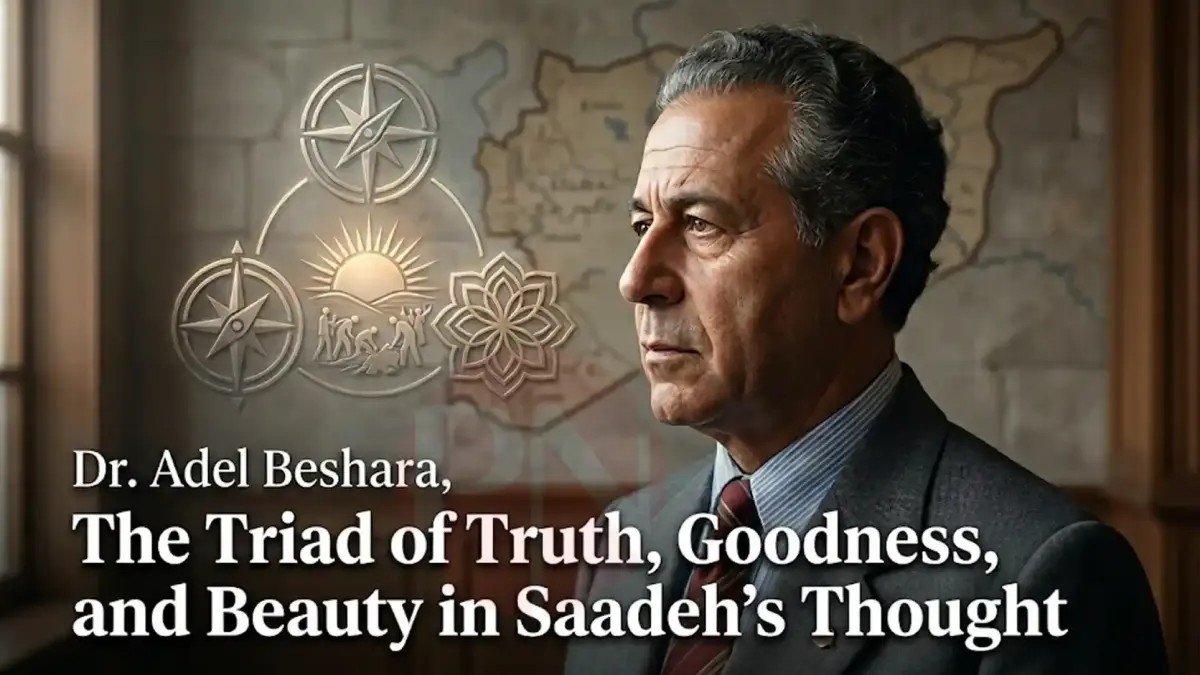
A recurring theme in Saadeh’s thought relates to the conceptional triad of truth, goodness and beauty, which functions as a foundational axis within his broader philosophical and cultural vision. He wrote: “When we develop self-doubt and set out to save truth, goodness and beauty feeling that, in order to do so, we have to save them from our very own victory, then we must concede that truth, goodness and beauty exist outside our cause. And what meaning could our cause possibly have if it is not built on truth, goodness and beauty? Elsewhere, he says: “For life, in all its beauty, goodness and beauty, is the ultimate aim. The aim - as may have been prematurely assumed to be until now – is not merely to attend to aspects of daily social life and its issues.”
What are we to make of Saadeh’s words? The first observation we make is that the concepts of truth, goodness, and beauty are not exclusive to the intellectual framework of Antun Saadeh. These three words have been the subject of much thought and controversy among philosophers throughout the ages. They still hold considerable challenge to our thinking in these days of confused values and gross materialism. They are absolutely universal properties of all reality.
Within Antun Saadeh’s discourse, the triad of truth, goodness, and beauty is not construed as a set of exclusively metaphysical attributes inhering in the divine. In classical religious frameworks, these values are typically understood as transcendent absolutes grounded in the nature of God, whose status as the ultimate source, sustainer, and telos of existence confers upon them an immutable and universal character, often functioning as normative coordinates for spiritual orientation.
By contrast, Saadeh approaches this triad through the prism of what he terms the overarching human reality—society. While he does not repudiate the metaphysical conception of God as an embodiment of truth, goodness, and beauty, he deliberately shifts analytical emphasis toward the immanent, lived dimension of these values. In doing so, he underscores their operative significance within the social sphere, where they acquire concrete expression and practical relevance in shaping human relations and collective life. In this secular non-religious perspective, “truth relates to the mind, goodness to the will, and beauty to the heart, feelings, desires, or imagination.”
A further observation is that Antun Saadeh, consistent with his characteristically optimistic orientation, conceives of the triad of truth, goodness, and beauty as ends in themselves rather than merely instrumental values. Their realization, in his view, entails an ongoing process of human striving in which individuals actively grapple with their meanings, labor toward their attainment, and mobilize the full range of their capacities in their pursuit.
Accordingly, insofar as these values are treated as human properties, they do not emerge independently of praxis; rather, they are constituted through sustained effort and a deeply rooted aspiration toward what is apprehended as the highest good. This orientation presupposes not only cognitive recognition of the triad but also participatory engagement with it, beginning from the immediacy of lived reality and extending toward its fuller actualization within the human condition. In Saadeh’s words, “if truth, goodness and beauty cannot be reinforced by any qualities in us, all the thinkers of the world combined would not be able to salvage them from our nature.” In other words, we must first have a firm belief in ourselves and a genuine meaning and purpose in life, if we are to understand or perceive the triad as they appertain to us: “We must have faith that we also possess the high social capability of every rational society to recognize what truth, goodness and beauty are. If these values exist but bear no relation to our society or encapsulate none of its truth or beauty or goodness, then there is no truth or goodness or beauty. What we ourselves cannot perceive as truth, goodness, and beauty, can never be truth, goodness, and beauty.”
For Antun Saadeh, truth, goodness, and beauty do not constitute fixed or immutable categories. Rather, like all dimensions of human experience, they are conditioned by the scope and capacities of human perception. Although their centrality within human life remains beyond dispute, their substantive content and formal articulation are inherently variable.
Accordingly, while these values enjoy broad recognition, their specific meanings and configurations differ across distinct societal contexts and lived realities, and are further shaped by both individual and collective modes of existential ontology.
Within the paradigm of Antun Saadeh, truth, goodness, and beauty are conceived as intrinsically interconnected and analytically inseparable. He neither isolates these values from one another nor privileges any single element of the triad at the expense of the others. Although he underscores the epistemic and moral necessity of distinguishing truth from falsehood, goodness from evil, and beauty from ugliness, such distinctions do not entail a hierarchical ordering among the triadic properties themselves.
Rather, Saadeh posits that human society is oriented toward the triad as an integrated whole, collectively striving toward its realization. This orientation is underpinned by a dynamic reciprocity: beauty attracts the human sensibility toward truth, truth orients action toward goodness, and goodness, in turn, restores and reaffirms beauty within the world. In this sense, the triad constitutes an indivisible unity, each element reinforcing and sustaining the others within a continuous cycle of human and social becoming.
For Antun Saadeh, the triad of truth, goodness, and beauty also assumes a distinctly revolutionary valence. These values function not merely as normative ideals but as catalysts for transformative action: they impel individuals and societies to reassess entrenched conditions, contest the fait accompli, and pursue progressive change despite adverse circumstances. He openly attacked those who “sought to impair the central reality of society by claiming that it does not have the ability to recognize, on its own, truth, goodness and beauty.” Thus, within the framework of Antun Saadeh, the pursuit of the triad presupposes at least two enduring constants: faith and perseverance. The capacity of a society to rise and inaugurate a renewed historical trajectory depends fundamentally on a cultivated sense of self-confidence and a deeply held conviction that its cause embodies the plenitude of truth, goodness, and beauty. As sayeth Saadeh, “Any acknowledgment on our part of truth, goodness and beauty in the world is conditional upon our own ability to discern that truth, that goodness and that beauty, or partake of their sensibility.”
Furthermore, in the thought of Antun Saadeh, truth, goodness, and beauty are conceived as interactive values operative at both the individual and the national levels. Their realization unfolds through reciprocal processes that link personal formation with collective life. Consequently, the ethos of any given society cannot be understood as wholly autonomous or insulated from the ethical and cultural formations of other societies. Yet this interdependence does not justify the imposition or uncritical transplantation of one society’s ethos onto another; rather, each society must articulate and cultivate these values in accordance with its own historical and existential conditions: “If we cannot see truth, or goodness or beauty ourselves we cannot possibly see the truth, goodness and beauty proclaimed by any other ethos. We have our own truth, goodness and beauty to perceive or to partake in their awareness: they must never be imposed on us because we possess a conscious, perceptive and a probing ethos that can discern these values (truth, goodness and beauty) and share in seeing them with its own capacity and its own spiritual, intellectual and emotional independence.”
In sum, within the framework of Antun Saadeh’s thought, the triad of truth, goodness, and beauty functions as a source of ultimate meaning for individual human existence. Saadeh appears to have been among the first Syrian thinkers to systematically foreground this triad as an integral component of his philosophical system, approaching it from a societal rather than a transcendental standpoint.
