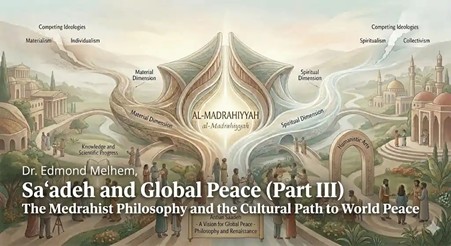
While Saʿadeh recognized the importance of regional cooperation as a step toward stability, his most profound contribution to global peace lies in his philosophical vision. Through what later came to be described as al-Madrahiyyah, Saʿadeh sought to provide a comprehensive alternative to the competing ideologies that shaped modern history. [1] His approach aimed not merely at political solutions but at a transformation in the intellectual and cultural foundations of human relations.
A Critique of Conflicting Ideologies
Saʿadeh observed that modern political and economic ideologies tended to interpret human life through a single lens. Whether materialist or spiritual, individualist or collectivist, each philosophy emphasized one aspect of existence while neglecting others. This one-sidedness, in his view, generated rivalry, domination, and conflict among societies. The clash of these partial philosophies contributed to global wars, economic crises, and deep social inequalities, revealing their inability to provide lasting stability. [2]
He therefore rejected the assumption that conflict between opposing principles is a necessary driver of human progress. Instead, Saʿadeh argued that humanity must move beyond destructive ideological struggle and seek a new framework based on integration and cooperation. He emphasized that the world could not remain trapped in a “deadly conflict” between material and spiritual interpretations of life, and that this conflict should be transformed into a constructive and harmonious interaction that fosters civilization and elevates culture. [3]
The Medrahist Principle: From Conflict to Interaction
At the core of Saʿadeh’s philosophical outlook lies the principle of interaction. Rather than eliminating differences, he proposed organizing them within a balanced system that integrates both material and spiritual dimensions of human existence. This synthesis forms the foundation of what he presented as a new philosophical approach capable of guiding humanity toward cooperation instead of confrontation. [4]
According to Saʿadeh, this balanced perspective provides the basis for a more stable and humane international order. By transforming conflict into interaction, societies can exchange knowledge, experiences, and cultural achievements, thereby enriching one another. In this sense, peace emerges not from domination but from the harmonious cooperation of diverse human communities. [5]
Cultural Advancement as the Basis of Peace
Saʿadeh’s philosophy places cultural advancement at the center of global peace. He viewed the elevation of knowledge, ethics, and creativity as essential conditions for improving human life. A society that cultivates culture and scientific awareness becomes better equipped to overcome narrow interests and contribute to humanity as a whole [6].
His vision extended beyond national renewal to a broader humanistic perspective. Saʿadeh emphasized that the goal of social transformation is the creation of “a better life in a more beautiful world and higher values.” [7] This aspiration reflects his belief that peace is inseparable from the moral and intellectual progress of humanity. Cultural development, therefore, becomes a means of replacing rivalry with cooperation and hostility with mutual understanding.
A Humanistic Vision for the Future
Saʿadeh’s outlook combined national revival with a universal human mission. He believed that the advancement of society should ultimately contribute to the progress of humanity and the reduction of conflict. In his writings, he linked the pursuit of freedom, justice, and dignity with the broader goal of improving human civilization. The ideal he envisioned was a world characterized by cooperation, ethical responsibility, and respect for diversity. [8]
This humanistic dimension reinforces the global relevance of his philosophy. By encouraging openness to world cultures and the exchange of knowledge, Saʿadeh’s approach promotes a dynamic form of peace grounded in interaction rather than isolation. Such a framework allows societies to maintain their individuality while participating in a shared civilizational development.
Conclusion
In this final perspective, Saʿadeh’s contribution to global peace appears primarily philosophical and cultural. His new outlook (al-Madrahiyyah) offers an alternative to competing ideologies by integrating material and spiritual dimensions, transforming conflict into interaction, and linking peace to cultural advancement. [9] This comprehensive vision moves beyond temporary political arrangements and proposes a civilizational path toward lasting peace.
Through this framework, peace becomes the outcome of a new human culture based on cooperation, knowledge, and ethical progress. Saʿadeh thus presents not only a national program of renewal but also a broader humanistic philosophy aimed at guiding humanity toward a more harmonious and constructive future.
[1] See the author’s work: SURVIVAL and REVIVAL- An analytical approach to Sa’adeh's national thought, Beirut, 2024, pp. 86 – 136.
[2] Ibid., pp. 105-107.
[3] Ibid., pp. 109-114.
[4] Ibid., pp. 108-109.
[5] Ibid.
[6] Ibid., pp. 105-109
[7] Ibid., p. 127.
[8] Ibid., pp. 128-130.
[9] Antun Sa’adeh. The Complete Works, Vol 3- 1938-1939, "The National Social Doctrine” (from the leader's speech at the national meeting at the 'Sharaf wa Wattan club in Buenos Aires in December 1939.)
