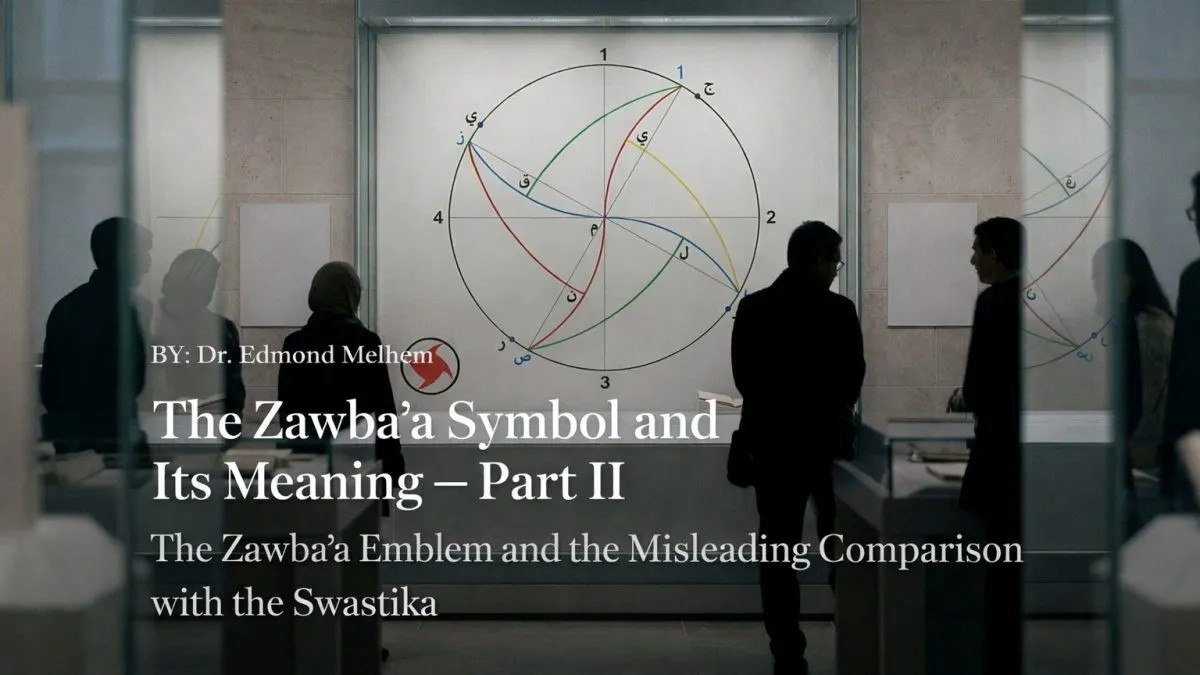
One of the most common accusations against the SSNP concerns its emblem, the Zawbaʿa (Hurricane). Critics often claim that it resembles the Nazi swastika [1]. However, this comparison relies solely on superficial visual similarity and ignores the symbol’s origin, design process, and philosophical meaning.
Antoun Sa´adeh explained that the Zawbaʿa was a new symbol created from the nation’s own creative spirit and not borrowed from any foreign ideology. It was conceived to represent the dynamic forces of the Social Nationalist renaissance.
He wrote:
“The Zawbaʿa (Hurricane) of the Syrian Social Nationalist Reform Party arose from a purely Syrian idea intended to symbolize popular unity through the removal of religious differences. This Zawbaʿa is the only way to bring together the cross and the crescent, interlocked and united in a solid union within a single movement. This is the meaning of the whirlwind symbol—not an imitation of the German swastika. [2]”
The choice of the Zawbaʿa was deliberate. According to the party’s official bulletin of 15 August 1947, the symbol was selected because it represented the revolutionary transformation brought about by the Social Nationalist renaissance in thought, values, and institutions. Sa´adeh asked party engineers and artists to propose designs expressing this idea. Several early models were submitted, including one composed of four crescents meeting at a central point. While this design symbolized the union of the cross and crescent, it lacked the sense of movement and structural strength required to convey the energy of a whirlwind.
The final form was proposed by the party member Bahij al-Khuri al-Maqdisi, who created a design inspired by the geometric structure of a cyclone. His proposal combined symbolic meaning with visual solidity, producing the emblem in its present form. The name “Zawbaʿa” itself was given by Sa´adeh, emphasizing motion, vitality, and concentrated force. [3]
The four arms of the Hurricane stand for freedom, duty, discipline, and power. Their rotation in a circular motion symbolizes vitality, interaction, and unity within society. The dynamic movement expresses the merging of different social and cultural elements into a single national life, represented symbolically by the integration of the cross and the crescent. The counter-clockwise rotation has also been interpreted as signifying a break with divisive historical patterns and the beginning of a new collective trajectory.
The colours of the emblem further reinforce its meaning. The red Hurricane appears within a white circle on a black background. These colours were defined in the party’s constitution: black symbolizes seriousness and steadfastness, white represents loyalty and clarity, and red expresses determination and strength. The contrast between black and red also reflects the idea of a new dawn emerging from darkness, echoing Sa´adeh’s description of the movement as arising “like dawn from the darkest hours of night.” [4]
Unlike the swastika, which became associated with racial hierarchy and exclusion, the Zawbaʿa represents unity, cooperation, and constructive movement. Its circular dynamism reflects continuity, renewal, and the interaction of social forces. For this reason, the symbol expresses a humanistic and social philosophy rather than a racial one.
Sa´adeh believed that every national renaissance must generate its own symbols organically from the life of its people. The Zawbaʿa was therefore intended to embody collective awakening, unity, and creative transformation—an emblem of movement and integration, not domination or imitation.
[1] See an article titled “Al-Huda’s absurdities” (ترهات الهدى) published in 194. See Antun Saadeh in His Forced Exile, 1944–1945, Complete Works, Vol. 12, pp. 38-44.
[2] Antun Saadeh in His Forced Exile, 1944–1945, Complete Works, Vol. 12, p. 43.
[3] Jibran Jurayj, Min al-Ju’bah (From the Case History) Vol. I, Beirut, 1985, pp. 116–118.
[4] Antun Sa´adeh, Al-Muhadarat al-'Ashr (The Ten Lectures), Beirut: SSNP, 1976, p. 28.
