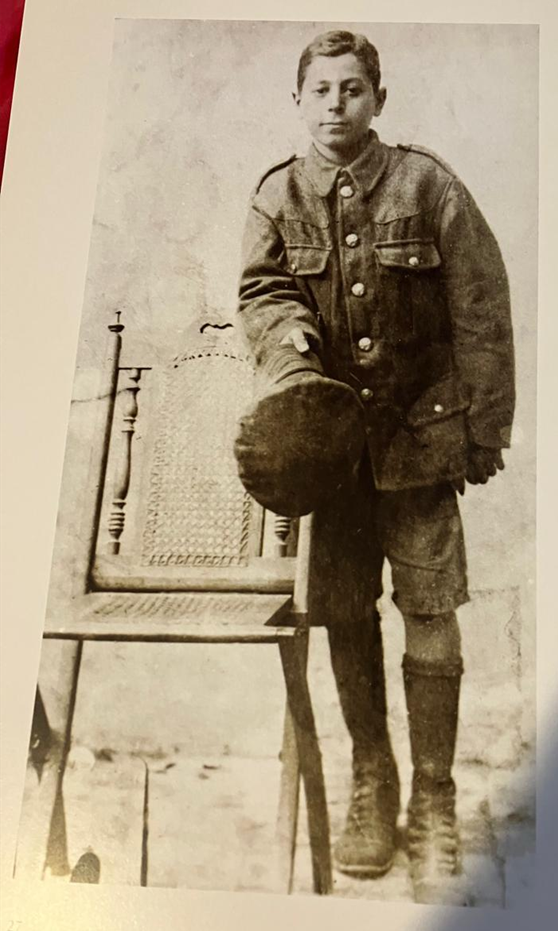
When Naifeh Nasir, the wife of Dr Khalil Sa’adeh, passed away in Egypt, the burden of raising their seven children became too heavy for him.
Since Naifeh’s family had emigrated to the United States, she herself had been raised and educated in American schools and spoke English fluently. For that reason, she gave all her children English names. When Anthony grew up, he decided to Arabize his name, changing it to Antun.
Dr Khalil Sa’adeh had also planned to leave Cairo after settling his affairs to join his elder sons. But the outbreak of the First World War in 1914 took him by surprise, as it did his children, cutting off all communication between them for four years—until the end of the war in 1918.
The war years were extremely difficult for the children, especially the younger ones in Lebanon, as their father could no longer send them money. Famine, war, and death swept through the land.
Antun was ten years old when the war broke out. Despite his young age, he found himself responsible for feeding his younger siblings and grandmother, with no money at hand. He volunteered to purchase supplies for the British soldiers and to serve as their interpreter, in exchange for which they gave him some food and clothing for himself and his siblings.
Dr. Nasib Hammam, a relative of Sa’adeh, once told me that Antun came to him one day carrying his little sister Grace, whose eyes were inflamed. Dr. Nasib gave him a small bottle containing the needed medicine free of charge. Since Antun had no money to buy a dropper, the boy used a piece of cotton: he dipped it into the bottle, then squeezed it gently over Grace’s inflamed eyes.
In the photograph above, taken in 1916 when he was twelve, we see Sa’adeh wearing a military outfit—because he and his siblings could not afford to buy clothes. The British soldiers gave him what they had in return for his work.
Later, the children were sent to Brummana School, which had been turned into a large shelter until the end of the war. The late former MP Albert Makhayber, who lived in Beit Mery near Brummana, once told me that his father had asked him to visit their relative Antun, since Albert’s mother was related to Dr Khalil. Albert asked his father:
— How will I recognize Antun?
His father replied:
— Look for the brightest student you see in the school—that will be Antun.
