Antoun Saadeh's Vision (Part 4)
The Basis for The Unification of Geographic Syria
Safia Antoun Saadeh
Saadeh presented a remarkably modern project for his time—one that remains contemporary even today, in an era witnessing the renewed rise of racist movements across Western nations, as recent elections in those countries clearly reveal.
He built his concept of the nation-state upon our own civilizational heritage of integration and openness. For him, everyone living on the land of the Fertile Crescent is a citizen, man or woman, equal in rights and duties, regardless of ethnic or religious origins. The model Saadeh envisioned stood in complete opposition to the Zionist model, which is founded on racist and religious exclusivity, rejects coexistence with the other under any circumstance, and maintains a perpetual state of war against all who are different.
Saadeh’s foremost priority was to restore Bilad al-Sham to its natural condition before Western intervention, which had legitimized the killing and displacement of the peoples of "Suraqia", and the settlement of foreign elements who seized the land under the pretext of the “racial superiority of the white man.” This notion was explicitly expressed by Britain’s Prime Minister, Winston Churchill, following the publication of the Peel Commission Report.
Saadeh criticized the fragmentation prevailing among the "Suraqian" entities, recognizing how it undermined the course of national liberation. In 1948, he called upon all to unite their fronts, declaring:
“Despite all the great calamities, the Syrian Nation has remained paralyzed in the face of the encroaching foreign forces and ambitions, because the factions that undertook political action were all of a reactionary, feudal, or tribal nature. All of them operated like limited-capital companies... Thus, were determined the separate issues of Mesopotamia, Syria, Lebanon, Palestine, and Transjordan. There was never a single issue encompassing all parts, gathering all forces together, and planned under one unified effort.”
(Antun Saadeh, “On the Palestinian Question,” p. 140 ff.)
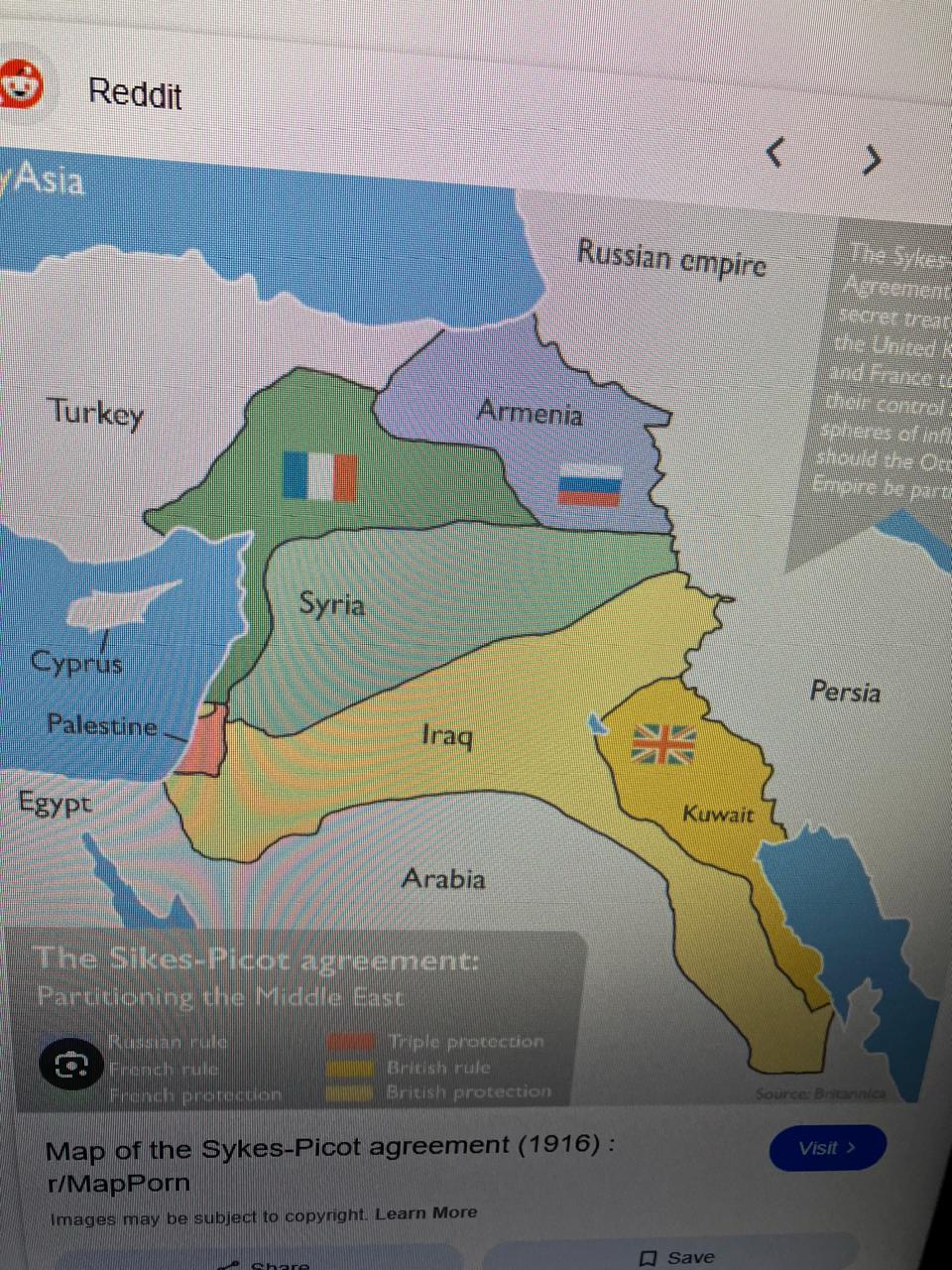
One of the unspoken goals of the 1916 Sykes–Picot Agreement was to pave the way for the 1917 Balfour Declaration, which promised to establish “a national home for the Jewish people” in Palestine. Lord Sykes—a committed Zionist—worked diligently to fragment the region in a way that would allow the creation of the State of “Israel” on Palestinian soil.
Sykes–Picot and the Balfour Declaration were inseparable projects—neither could have been implemented without the other. This dynamic persists to this day. The United States, inheritor of the British Empire, does not permit any genuine rapprochement among the states of Suraqia. On the contrary, it works tirelessly to ignite conflicts among them and to reinforce divisions. It has even established American military bases along the borders between Syria, Iraq, and Jordan, and is attempting to do the same between Syria and Lebanon.
The United States fully understands—just as Britain once did—that any form of unity among the Fertile Crescent states poses an existential threat to “Israel”.
