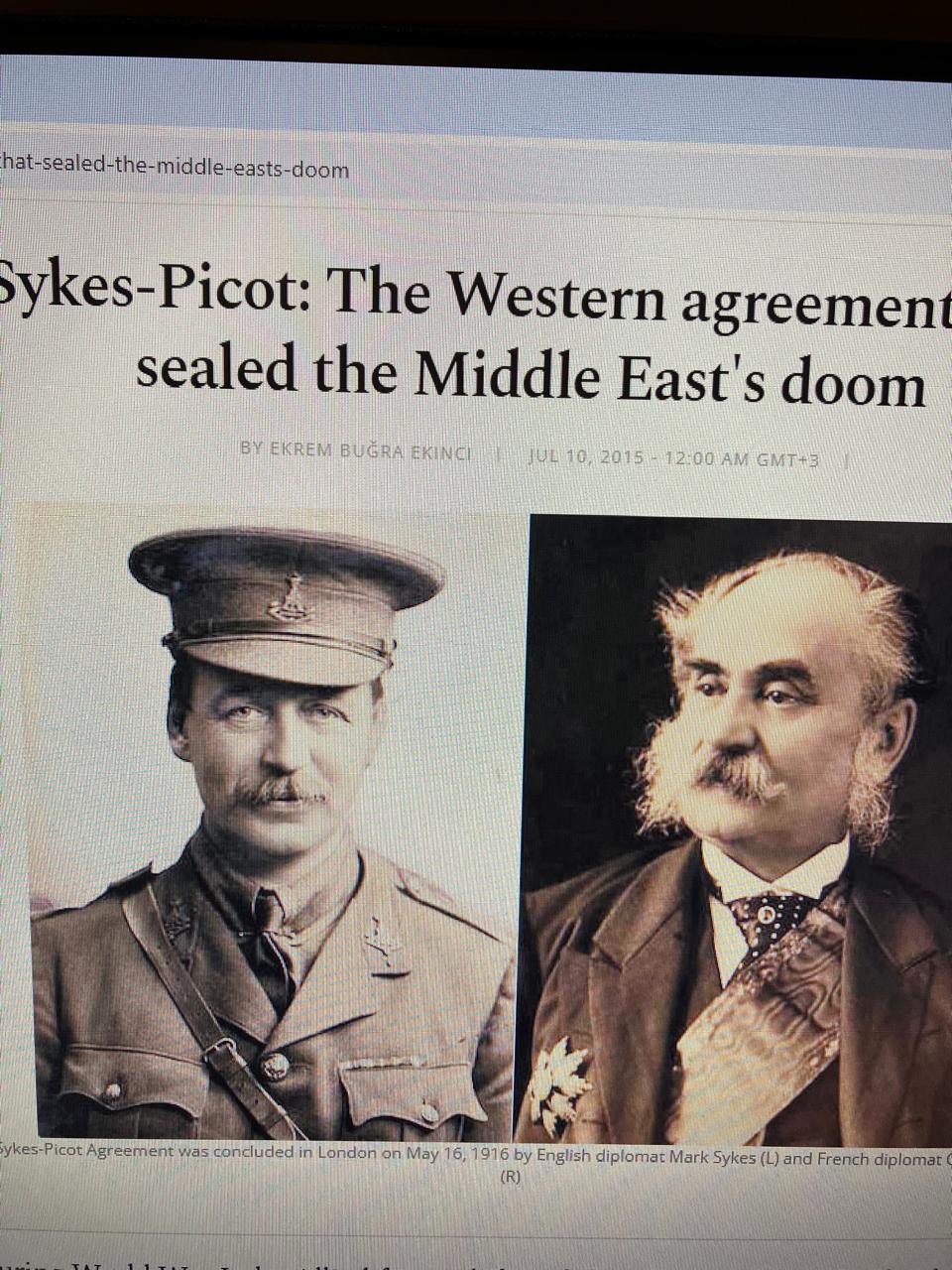
During WW1, the Allied forces defeated the Ottoman Empire and redrew the map of the Middle East for the post-war European colonial period. To protect their interests, artificial borders were drawn, ignoring regional features and sowing the seeds of conflict that continue today.
To confront Western colonialism, it was essential to work toward the abolition of the British–French Sykes–Picot Agreement and to define the contours of this “Suraqian” nation. In the 1930s, Saadeh had referred to it as “Natural Syria”, whose boundaries, in his view, extended to the Euphrates River. However, after extensive studies, he concluded that Iraq was part of this same civilization, since the desert that now separates the two countries did not exist in ancient or medieval times in the Fertile Crescent. This indicated a continuous cultural and historical connection. Thus, in 1947, he included Iraq as part of this nation-state and expressed his readiness to change the name from Natural Syria to “Suraqian”.
When Saadeh returned from Argentina in 1947, he rented a house for himself and his family, opposite Khalidi Hospital in Ras Beirut. Coincidentally, Satiʿ al-Husri, the Arab nationalist thinker, was living on the third floor, while Saadeh resided on the first.
Khaldun, Satiʿ al-Husri’s son, told me that when his father learned that Saadeh had adopted the concept of Suraqian unity, he was very pleased and regarded it as a significant point of convergence with his own vision.
